
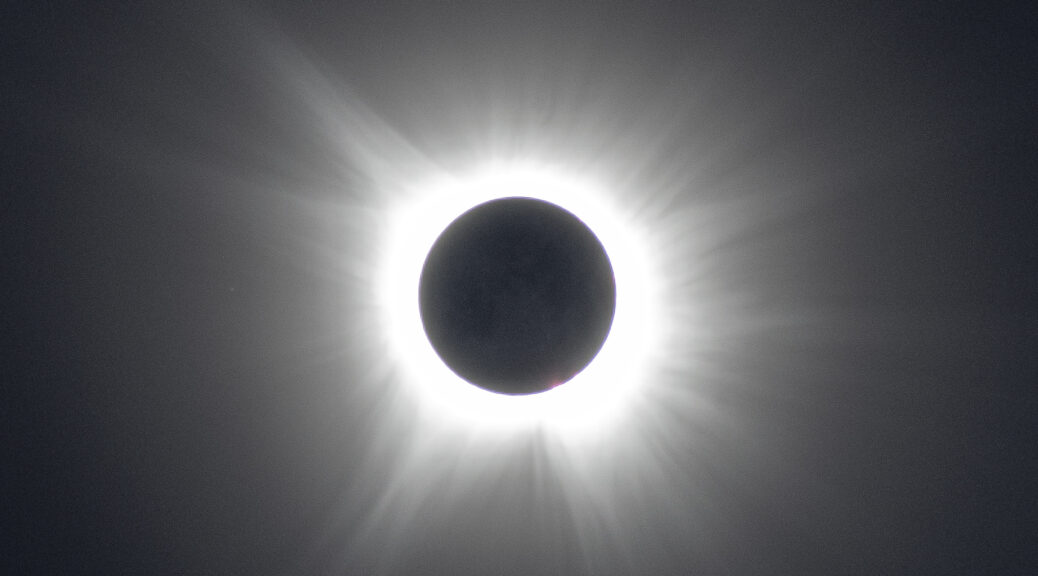

A solar eclipse occurs when the Moon passes between the Earth and the Sun, casting a shadow on the Earth and blocking some or all of the Sun’s light from reaching the surface. This alignment can only happen during a new moon, when the Moon is positioned directly between the Earth and the Sun. The type of solar eclipse experienced depends on the distance between the Earth and the Moon, the observer’s location, and how precisely the Sun, Moon, and Earth line up. Regardless of type, solar eclipses are dramatic celestial events that reveal the intricate mechanics of our solar system in action.
A total solar eclipse happens when the Moon completely covers the Sun’s disk, casting the darkest part of its shadow—the umbra—on the Earth. For observers within this narrow path of totality, day briefly turns to night, temperatures drop, and stars and planets may become visible in the sky. The most breathtaking moment occurs when the Sun’s corona, its outer atmosphere, becomes visible as a shimmering halo around the dark Moon. However, totality is only visible from a small area on Earth and lasts just a few minutes.
An annular solar eclipse occurs when the Moon is too far from Earth to completely cover the Sun. Because the Moon appears smaller in the sky, it leaves a bright ring of sunlight visible around its edges—this glowing ring is known as the “ring of fire.” Though the Sun is never entirely blocked during an annular eclipse, the alignment is still precise, and the event can be quite striking. Unlike total eclipses, however, the Sun’s corona is not visible, and the sky does not darken as dramatically.
A partial solar eclipse happens when only part of the Sun is obscured by the Moon. This can occur either when the alignment is slightly off-center or when an observer is outside the path of totality or annularity. The Sun appears as a crescent or has a “bite” taken out of it, depending on how much of its surface is covered. While partial eclipses are more common and visible over a larger area than total or annular eclipses, proper eye protection is always necessary, as looking directly at the Sun—even when partially covered—can cause serious eye damage.