Emission nebulae are colorful, glowing clouds of ionized gas found in interstellar space, often marking regions of active star formation. They are primarily composed of hydrogen gas, which becomes energized—or ionized—by the intense ultraviolet radiation emitted by nearby young, hot stars, typically of spectral types O and B. When the high-energy radiation strips electrons from hydrogen atoms, the atoms later recombine, releasing energy in the form of visible light. This process causes the nebula to emit its own light, giving it a brilliant glow—most often a reddish hue due to the specific emission line of hydrogen-alpha.
Emission nebulae are often found in stellar nurseries, where new stars are being born out of collapsing clouds of gas and dust. The famous Orion Nebula (M42) is a prime example of an emission nebula, showcasing bright, turbulent regions lit by young stars. These nebulae can span dozens to hundreds of light-years and often have complex structures, shaped by stellar winds, radiation pressure, and magnetic fields. Over time, the energetic output from new stars can disperse the gas of the nebula, ending the star formation process in that region. Emission nebulae are not only visually stunning but also essential to understanding the life cycle of stars and the evolution of galaxies.
The images below are ones that I’ve taken of emission nebula.
Click on any of the images below to go to the gallery for a better view and details related to each image.
M20, The Trifid Nebula in Sagittarius with the open cluster M21 to its upper left.
M20, The Trifid Nebula in Sagittarius with the open cluster M21 to its upper left.
The California Nebula, NGC 1499 in Perseus.
This is NGC 1499, the California Nebula in Perseus. The California Nebula gets its name from its resemblance to the outline of the state, glowing brightly in rich hydrogen-alpha light. Located about 1,000 light-years away in the constellation Perseus, this large emission nebula spans roughly 100 light-years across. Its distinctive red glow comes from ionized hydrogen energized by the nearby hot, blue O-type star Xi Persei (Menkib), which floods the region with intense ultraviolet radiation.
Acquisition Details:
Date: Nov. 16, 2025
Scope: Meade 70mm Quad APO Astrograph
Camera: QHY183C
Mount: Celestron AVX
Guide Scope: ZWO H30 F4 Mini
Guide Camera: ASI120MM Mini
Filter: Optolong L-eXtreme
Integration: 135 x 120s (4 Hrs. 30 mins.)
Software: N.I.N.A., Stellarium, Deep Sky Stacker, SASpro, Adobe Photoshop
The Soul Nebula (IC 1848) in Cassiopeia.
The Soul Nebula (IC 1848) is located about 6,500 light-years away in the constellation Cassiopeia, the Soul (also known as the Embryo Nebula) is a massive star-forming region filled with glowing hydrogen gas, newborn star clusters, and intricate filaments sculpted by stellar winds. It spans 100-150 light years across. Its shape has long been said to resemble a human heart or "soul," especially when paired with its neighbor, the Heart Nebula (not pictured), forming one of the sky’s most iconic deep-sky duos.
Acquisition Details:
Date: Nov. 14, 2025
Scope: Meade 70mm Quad APO Astrograph
Camera: QHY183C
Mount: Celestron AVX
Guide Scope: ZWO H30 F4 Mini
Guide Camera: ASI120MM Mini
Filter: Optolong L-eXtreme
Integration: 136 x 120s (4 Hrs. 32 mins.)
Software: N.I.N.A., Stellarium, Deep Sky Stacker, SASpro, Adobe Photoshop
Over 4 hours of data on the Horsehead (IC 434) and Flame (NGC 2024) nebulae in Orion.
Taken with the ZWO SeeStar S30 in EQ mode on the Skywatcher Star Adventurer wedge and tripod this is over 4 hours of data on the Horsehead (IC 434) and Flame (NGC 2024) nebulae in Orion. Post processing was done in the SeeStar app using Auto DBE, Denoise and other slight tweaking.
The Butterfly Nebula (IC 1318), a gorgeous emission nebula in the heart of the constellation Cygnus, the Swan.
The Butterfly Nebula (IC 1318), a gorgeous emission nebula in the heart of the constellation Cygnus, the Swan. Despite its name, it’s not a single object but a vast complex of glowing hydrogen gas and dark dust lanes, lying about 4,000–5,000 light-years away. The “butterfly” shape comes from these dark dust clouds cutting through the bright red emission, giving the appearance of delicate wings spread wide.
IC 1318 is located near the bright star Sadr (Gamma Cygni) located to the right of center in the shot below, which marks the Swan’s chest in the Summer Triangle asterism. This whole region is a stellar nursery, where new stars are forming inside dense molecular clouds. The light we see is powered by nearby hot, young stars whose ultraviolet radiation ionizes the hydrogen gas, causing it to glow in those rich crimson hues captured in long-exposure astrophotography.
Cygnus itself is one of the most rewarding areas of the summer sky, packed with nebulae, star clusters, and deep-sky treasures. Point a telescope or camera here, and you’re looking straight into one of the most crowded and active star-forming regions in our galaxy.
Acquisition Details: 70mm Meade Quad APO Astrograph, AVX mount, QHY183C CMOS camera, Optolong L-eXtreme dual band narrowband filter, (156x120s) 5 hours 12 minutes of data taken on August 8, 2025. Processed using DSS, SAS, Ps.
The Pelican Nebula (IC 5070), a beautiful emission nebula in the constellation Cygnus, right next to the more famous North America Nebula.
The Pelican Nebula (IC 5070), a beautiful emission nebula in the constellation Cygnus, right next to the more famous North America Nebula.
This cosmic pelican is located about 1,800 light-years away and spans over 30 light-years across. The rich red and orange glow comes from hydrogen gas ionized by young, hot stars, while dark tendrils of interstellar dust carve out the nebula’s “beak” and “eye.” Within these clouds, new stars are actively forming, their radiation sculpting the surrounding gas into intricate shapes.
The Pelican Nebula is a favorite target for astrophotographers because of its fine textures and complex interplay of light and shadow. It’s part of a massive star-forming region in our Milky Way — a reminder that our galaxy is still hard at work building new suns.
From Earth, it’s just a tiny patch in the sky near Deneb, but through the camera and telescope, it becomes an epic landscape of creation and beauty.
Acquisition Details: 70mm Meade Quad APO Astrograph, AVX mount, QHY183C CMOS camera, Optolong L-eXtreme dual band narrowband filter, (126x120s) 4 hours 12 minutes of data taken on August 8, 2025. Processed using DSS, SAS, Ps.
Three deep space objects all in the same field of view. This image features the Open Star Cluster M52 (Messier 52), the Bubble Nebula (NGC 7635) both in Cassiopeia, and the lesser-known but equally stunning Northern Lagoon Nebula Sh2-157 (Sharpless 157) which lies in Cepheus.
3 deep sky objects, two constellations and one frame. The Bubble Nebula, M52 and The Northern Lagoon Nebula.
Three deep space objects all in the same field of view. This image features the Open Star Cluster M52 (Messier 52), the Bubble Nebula (NGC 7635) both in Cassiopeia, and the lesser-known but equally stunning Northern Lagoon Nebula Sh2-157 (Sharpless 157) which lies in Cepheus.
M52 is a bright, compact open star cluster about 5,000 light-years away. It's made up of a few hundred young stars and is estimated to be around 35 million years old—a true cosmic nursery still glowing with youthful energy.
Just next door is the Bubble Nebula, a remarkable emission nebula sculpted by the fierce stellar winds from a massive O-type star at its center. That bubble-like shell is actually 7 light-years wide—about 1.5 times the distance between our Sun and the closest star! It looks delicate, but it’s formed by powerful forces.
And off to the right side lies the Northern Lagoon Nebula, cataloged as Sharpless 2-157. This elegant structure of glowing gas and dark dust is part of a larger star-forming region, stretching about 70 light-years across. It's often overlooked but absolutely worth the attention.
Acquisition Details: 70mm Meade Quad APO Astrograph, AVX mount, QHY183C CMOS camera, Optolong L-eXtreme dual band narrowband filter, (120x120s) 4 hours of data taken on August 7, 2025. Processed using DSS, SAS, Ps.
NGC 6888, the Crescent Nebula, glowing in the heart of the constellation Cygnus, about 4,700 light-years away.
This beautiful emission nebula is actually a cosmic bubble, created by the powerful stellar winds of a massive Wolf-Rayet star known as WR 136.
NGC 6888, the Crescent Nebula, glowing in the heart of the constellation Cygnus, about 4,700 light-years away.
This beautiful emission nebula is actually a cosmic bubble, created by the powerful stellar winds of a massive Wolf-Rayet star known as WR 136. This star, about 20 times the mass of the Sun, is shedding its outer layers at an incredible rate. As the fast wind from its current life stage slams into slower-moving material it ejected earlier, the gas heats up and lights up in a spectacular display of hydrogen (red) and oxygen (blue-green) emissions.
The Crescent Nebula spans about 25 light-years across, but it’s far too faint to see with the naked eye — even through a telescope it requires dark skies and patience. Thankfully, long-exposure astrophotography lets us capture the intricate filaments and delicate details hidden in this stellar bubble.
Cygnus is full of wonders. The Crescent is a reminder that even in its death throes a massive star can create something breathtakingly beautiful.
Acquisition details: 70mm Quad APO Astrograph, AVX mount, QHY183C CMOS camera, Optolong L-eXtreme dual band narrowband filter, (100x120s) 3 hours of data taken on July 31, 2025. Processed using DSS, SAS, Ps.
The Tulip Nebula Sh 2-101 (Sharpless 101) in Cygnus.
The beautiful Tulip Nebula, a glowing cloud of gas and dust about 6,000 light-years away in the constellation Cygnus. Its delicate “tulip” shape is sculpted by stellar winds and intense ultraviolet light in this busy star-forming region. The Tulip or Sh 2-101 (Sharpless 101) was cataloged in 1959 by astronomer Stewart Sharpless, and it sits in a fascinating part of the sky — close to Cygnus X-1, one of the first confirmed black hole candidates. A cosmic flower, grown in the garden of the Milky Way.
Acquisition details: 70mm Quad APO Astrograph, AVX mount, QHY183C CMOS camera, Optolong L-eXtreme dual band narrowband filter, (143x120s) 4 hours 46 minutes of data taken on July 30, 2025. Processed using DSS, SAS, Ps.
M16 — the stunning Eagle Nebula! Located about 7,000 light-years away in the constellation Serpens.
M16 — the Eagle Nebula. Located about 7,000 light-years away in the constellation Serpens, the Eagle Nebula is a vast star-forming region made famous by the Hubble Space Telescope’s iconic “Pillars of Creation” image. These towering columns of gas and dust stretch several light-years long and are nurseries where new stars are actively being born. The entire nebula spans roughly 70 light-years and glows with ionized hydrogen gas energized by the intense radiation of young, massive stars in the open cluster NGC 6611, embedded within the nebula itself.
Discovered in 1745 by Swiss astronomer Jean-Philippe de Chéseaux and later cataloged by Charles Messier, M16 is estimated to be around 1 to 2 million years old — relatively young in astronomical terms. The Eagle shape that gives the nebula its name is created by the dark dust lanes silhouetted against the brighter background gas.
Acquisition details: 70mm Quad APO Astrograph, AVX mount, QHY183C CMOS camera, Optolong L-eXtreme dual band narrowband filter, (124x120s) 4 hours 8 minutes of data taken on July 28, 2025. Processed using DSS, SAS, Ps.
The Swan Nebula, M17 in the constellation Sagittarius is one of the brightest and most massive star-forming regions in our galaxy.
The Swan Nebula, M17 in the constellation Sagittarius is one of the brightest and most massive star-forming regions in our galaxy. This active region is known by several names including the Omega, Swan, Horseshoe or Lobster Nebula (depending on how you see it), I have always referred to it as the Swan nebula. This glowing cloud of gas and dust is about 5,500 light-years away and stretches roughly 15 light-years across. The intense ultraviolet radiation from newborn stars within it is energizing the surrounding hydrogen gas, causing it to glow in these vivid shades of pink and red. Acquisition details: Meade 70mm Quad APO Astrograph, AVX mount, QHY183C CMOS camera, Optolong L-eXtreme dual band narrowband filter, 3 hours 28 minutes of data taken on the nights of July 19, 21 and 22, 2025.
The North America Nebula (NGC 7000, Caldwell 20) is a large and bright emission nebula located in the constellation Cygnus.
This is NGC 7000, also known as the North America Nebula. It is a large and bright emission nebula located in the constellation Cygnus, the Swan. It gets its popular name from its remarkable resemblance to the shape of the North American continent. This nebula lies about 2,500 light-years away from Earth and spans an impressive 100 light-years across, making it appear several times the size of the full Moon in the night sky—though it’s faint and mostly visible through astrophotography.
NGC 7000 is part of a larger complex of gas and dust that also includes the neighboring Pelican Nebula (IC 5070) not seen here. Both regions are rich in hydrogen gas, which glows red due to ionization from nearby young, hot stars. Though the exact stars responsible for ionizing the gas are hidden behind dense clouds of dust, it's believed that a particularly hot and massive star buried within is energizing the entire region. The dark rift separating the "Gulf of Mexico" from the "Atlantic" in the nebula’s outline is caused by thick dust lanes blocking the background emission. The bright, prominent ridge in the lower left of the image is an active star forming region that's 20 light-years long and known as the "Cygnus Wall." NGC 7000 is a favorite among astrophotographers due to its scale, structure, and rich star field, especially during the summer months in the Northern Hemisphere.
Acquisition details: 70mm Quad APO Astrograph, AVX mount, QHY183C CMOS camera, Optolong L-eXtreme dual band narrowband filter, 3.5 hours of data taken on July 24, 2025. Processed using DSS, SAS, Ps.
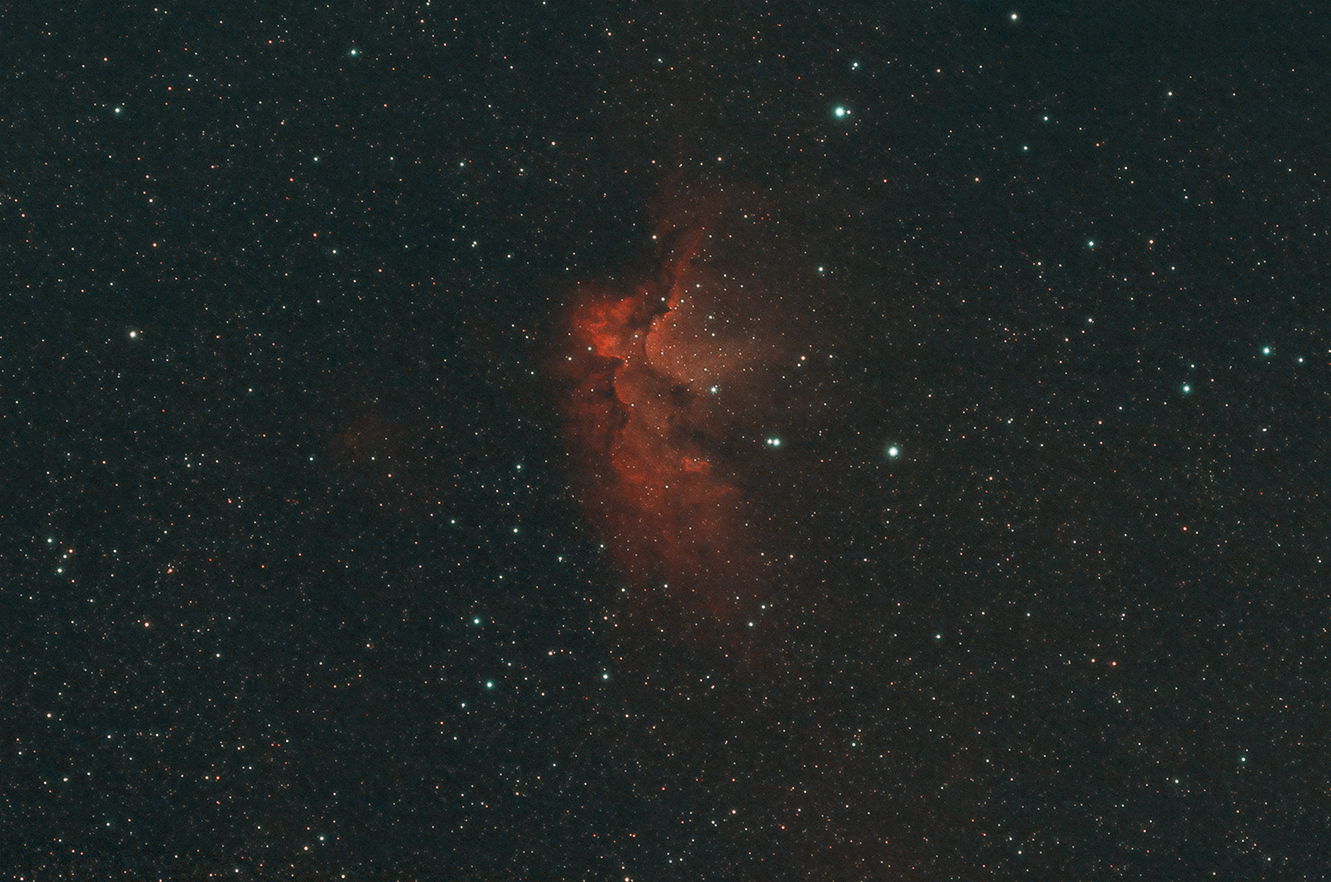
The Wizard Nebula, NGC 7380 in Cepheus
The Wizard Nebula, NGC 7380 located in the northern circumpolar constellation Cepheus. This nebula appears to me like a seated sorcerer or wizard with his pointed Harry Potter "sorting hat" on his head. What do you make of it? This cloud of interstellar gas and young stars is about 7200 ly from us. The image below is the result of just shy of 3 hours worth of 2 minute exposures that were stacked to bring out detail and reduce noise.. Acquisition Details: Date: Oct. 11-12, 2024 Scope: Meade 70mm Quad APO Astrograph, Camera: QHY183C, Gain 11, Offset 30, Mount: Celestron AVX, Guide Scope: ZWO H30 F4, Mini Guide Camera: ASI120MM Mini, Filter: Optolong L-eXtreme, Integration: 88 x 120s, Camera Temp: -15c Bin 1 Software: N.I.N.A., Deep Sky Stacker, Adobe Photoshop, PhotoKemi Star Tools, 20 Darks, 40 Flats, 40 Dark Flats.
The Pacman Nebula NGC 281 in Cassiopeia.
The Pacman Nebula NGC 281 in Cassiopeia. This nice little emission nebula is located in Cassiopeia and is about 9400 light years away and about 48 light years across.
Acquisition Details: Date: Nov. 3, 2023 Scope: Meade 70mm Quad APO Astrograph Camera: QHY183C Gain 11, Offset 30 Mount: Celestron AVX Guide Scope: ZWO H30 F4 Mini Guide Camera: ASI120MM Mini Filter: Optolong L-eXtreme Integration: 88 x 120s (2 Hrs. 56 mins.) Camera Temp: -15c, Bin 1, Software: N.I.N.A., Stellarium, Deep Sky Stacker, Seti Astro's Suite, Adobe Photoshop, 30 Darks, 40 Flats, 40 Dark Flats.
The Cave Nebula in Cepheus.
The Cave Nebula is located about 2400 light years from our solar system in the direction of the constellation Cepheus. Acquisition Details: Date: Oct. 7-9, 2023 Scope: Meade 70mm Quad APO Astrograph Camera: QHY183C Gain 11, Offset 30 Mount: Celestron AVX Guide Scope: ZWO H30 F4 Mini Guide Camera: ASI120MM Mini Filter: Optolong L-eXtreme Integration: 114 x 180s (5.7 Hrs.) Camera Temp: -15c, Bin 1, Software: N.I.N.A., Stellarium, Deep Sky Stacker, Adobe Photoshop, PhotoKemi Star Tools, 30 Darks, 40 Flats, 40 Dark Flats.
The Rosette Nebula NGC 2244 is an H II region in Monoceros.
The Rosette Nebula NGC 2244 is an H II region in Monoceros. Acquisition Details: Date: March 25-26, 2023 Scope: Meade 70mm Quad APO Astrograph Camera: QHY183C, Gain 11, Offset 30 Mount: Celestron AVX Focuser: ZWO EAF GuideScope: ASI120MM mini guide scope/camera Filter: Optolong L-eXtreme Integration: 90 @ 120s (3 hrs) Camera Temp: -15c Software: N.I.N.A, Deep Sky Stacker, Seti Astro's Suite, Photoshop, 20 Darks, 40 Flats, 40 Dark Flats.
The Heart Nebula (IC 1805) located in Cassiopeia. The Fish Head Nebula (IC 1795) is also in the field of view at lower right.
The Heart Nebula (IC 1805) and the Fish Head Nebula (IC 1795) at lower right located in Cassiopeia. The Heart Nebula is located about 7500 light years from Earth. This image was processed with only two hours of data. I'll revisit this target in the future and hopefully get more data. Acquisition Details: Date: Feb. 5, 2023 Scope: Meade 70mm Quad APO Astrograph Camera: QHY183C, Gain 11, Offset 30 Mount: Celestron AVX, Guide Scope: ZWO H30 F4 Mini, Guide Camera: ASI120MM Mini, Filter: Optolong L-eXtreme, Integration: 40 x 180s (2 Hrs.), Camera Temp: -15c, Bin 1, Software: N.I.N.A., Stellarium, Deep Sky Stacker, Adobe Photoshop, PhotoKemi Star Tools, 20 Darks, 40 Flats, 40 Dark Flats.
The Elephant's Trunk Nebula in Cepheus.
The Elephant's Trunk Nebula, IC 1396. This is the central region of the emission nebula IC 1396. It's 2,400 light years away in the constellation Cepheus.
Acquisition Details:
Date: Oct. 26, 2022
Scope: Meade 70mm Quad APO Astrograph
Camera: QHY183C Gain 11, Offset 30
Mount: Celestron AVX
Guide Scope: ZWO H30 F4 Mini
Guide Camera: ASI120MM Mini
Filter: Optolong L-eXtreme
Integration: 57 x 180s (2 Hrs. 51 Min.)
Camera Temp: -15c
Bin 1
Software: N.I.N.A. Stellarium, Deep Sky Stacker, Adobe Photoshop, PhotoKemi Star Tools
20 Darks
40 Flats
40 Dark Flats
M8, The Lagoon nebula in Sagittarius. Shot during full moon with Optolong L-eXtreme filter.
I shot M8 over a couple of nights through high thin haze and the full Moon. The Optolong L-eXtreme dual band narrow band filter I used just allows Ha and OIII to hit the camera sensor, and that's what made this image possible. This giant interstellar cloud in the constellation Sagittarius is 4100 ly distant from us and 110 by 50 ly in size. Acquisition Details: Date: Aug. 12-13, 2022 Scope: Meade 70mm Quad APO Astrograph Camera: QHY183C Gain 11, Offset 30 Mount: Celestron AVX Guide Scope: ZWO H30 F4 Mini Guide Camera: ASI120MM Mini Filter: Optolong L-eXtreme Integration: 94 x 120s (3 Hrs. 8 mins.) Camera Temp: -15c Bin 1 Software: N.I.N.A. Stellarium, Deep Sky Stacker, Seti Astro's Suite, Adobe Photoshop, 10 Darks 40 Flats 40 Dark Flats.
The Cone Nebula (NGC 2264) in Monoceros (The Unicorn).
This is 5.1 hours of data of the The Cone Nebula (NGC 2264), with the Christmas Tree Cluster, Snowflake Cluster and Fox Fur Nebula. These objects are located in the constellation Monoceros (The Unicorn). This is a fairly bright nebula with an overall magnitude of 3.9 that is located 2400 light-years from Earth. The variable star S Monocerotis (bright star in the middle) represents the tree's trunk. The star just off the tip of the cone is the top of the tree.
Acquisition Details:
Date: March 19th, 25th & 26th, 2022
Scope: Meade Series 6000 70mm Quad APO Refractor
Camera: QHY183C
Mount: Celestron Advanced VX
Focuser: ZWO EAF
Guide Scope: ZWO 30 F4 MINI
Guide Camera: ASI120MMmini
Filter: Optolong L-eXtreme
Integration: 102 x 180s (5 hrs. 6 min.)
Camera Temp: -15 C
Software: N.I.N.A., Stellarium, Deep Sky Stacker, Adobe Photoshop, PhotoKemi Star Tools
20 Darks
40 Flats
40 Dark Flats
I shot “The Flaming Star” nebula with my telescope and QHY183C camera while the Moon was out.
I shot “The Flaming Star” nebula with my telescope and QHY183C camera while the Moon was out. I was able to do so by using the Optolong L-eXtreme dual-band narrow band filter.
The Flaming Star nebula also known as IC 405 is located in the constellation Auriga (The Charioteer). This nebula is about 1,500 light-years away.
Acquisition Details: Date: March 12th and 15th, 2022 Scope: Meade Series 6000 70mm Quad APO Refractor Camera: QHY183C Mount: Celestron Advanced VX Focuser: ZWO EAF Guide Scope: ZWO 30 F4 MINI Guide Camera: ASI120MMmini Filter: Optolong L-eXtreme Integration: 87 x 180s (4 hrs. 21 min.) Camera Temp: -15 C Software: N.I.N.A., Stellarium, Deep Sky Stacker, Seti Astro's Suite, Adobe Photoshop, 20 Darks 40 Flats 40 Dark Flats
The Horsehead and Flame Nebulas in Orion.
This is the Horsehead and Flame nebulas in Orion. The Horsehead is designated Barnard 33 and is actually a dark nebula which sits in front of deep red emission nebula known as IC 434. The orangish Flame nebula on the left side is designated as NGC 2024 and there is a small blue reflection nebula, NGC 2023, below and left of the Horsehead. Near the bottom center is a very small reflection nebula, IC 435. The whole complex is approximately 1,500 light-years away and is all part of the Orion Molecular Cloud.
The second magnitude star Alnitak (the left most star in the belt of Orion) is the bright star above the Flame.
Acquisition Details:
Date: Nov 28, 2021
Scope: Meade 70mm Quad APO Astrograph
Camera: QHY183C, Gain 11, Offset 30
Mount: Celestron AVX
Focuser: ZWO EAF
GuideScope: ASI120MM mini guide scope/camera
Filter: Optolong L-eXtreme
Integration: 37 @ 120s (1h 14m)
Camera Temp: -15c
Software: N.I.N.A, Deep Sky Stacker, Photoshop 2022, PhotoKemi Star Tools
20 Dark
40 Flat
40 Dark Flat
The Monkey Head Nebula in Orion.
The Monkey Head Nebula NGC 2174 and the star cluster NGC 2175. This emission nebula is 6,400 light years away in the northern part of the constellation Orion.
Acquisition Details:
Date: Feb. 27, 2022
Scope: Meade 70mm Quad APO Astrograph
Camera: QHY183C Gain 11, Offset 30
Mount: Celestron AVX
Guide Scope: ZWO H30 F4 Mini
Guide Camera: ASI120MM Mini
Filter: Optolong L-eXtreme
Integration: 60 x 180s (3 Hrs.)
Camera Temp: -15c
Bin 1
Software: N.I.N.A. Stellarium, Deep Sky Stacker, Adobe Photoshop, PhotoKemi Star Tools
20 Darks
40 Flats
40 Dark Flats
NGC 2244, The Rosette Nebula with the SeeStar S30.
NGC 2244, The Rosette Nebula in Monoceros taken with the SeeStar S30. 90 minutes of integration, tweaked and denoised in the app.
Current amateur astronomy information such as points of interest and events in the night sky, star party dates, educational information, telescopes buying tips and much more.