
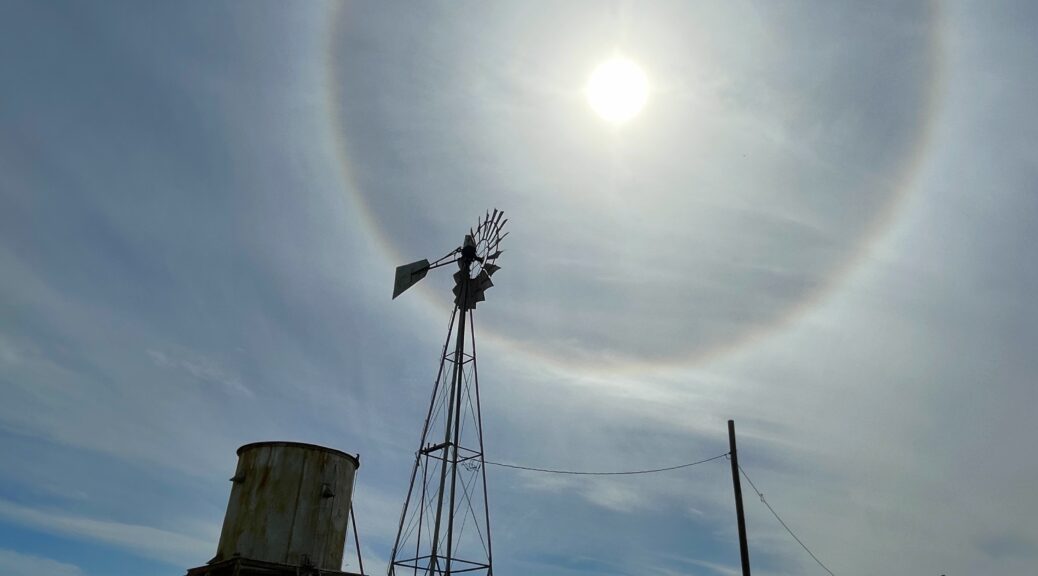
Solar halos are captivating optical phenomena that occur when thin, high-altitude cirrus or cirrostratus clouds drift across the sky. These delicate, wispy clouds contain countless tiny hexagonal ice crystals, which interact with sunlight in a very specific way. As sunlight enters one side of the ice crystals and exits another, the light is refracted—or bent—by a fixed angle, most commonly 22 degrees. This bending of light creates a luminous ring around the Sun, known as a 22-degree halo, which is the most frequently observed type. Sometimes, when the atmospheric conditions are just right, the halo can display subtle yet beautiful colors, often with reddish hues on the inner edge and bluish tones toward the outer rim.
Solar halos are typically visible when the Sun is high in the sky and partially veiled by these thin cloud layers. Because the ice crystals are randomly oriented, the halo forms a perfect circle centered on the Sun. While solar halos are more noticeable and common than their lunar counterparts due to the Sun’s greater brightness, they still require the right combination of sunlight, ice crystals, and observer position. These halos are not only visually stunning but can also serve as natural weather indicators. Since cirrostratus clouds often precede a warm front or incoming storm system, the appearance of a solar halo may hint at changing weather within the next 24 to 48 hours.
Click on any of the images below for a better view and photo details.


