
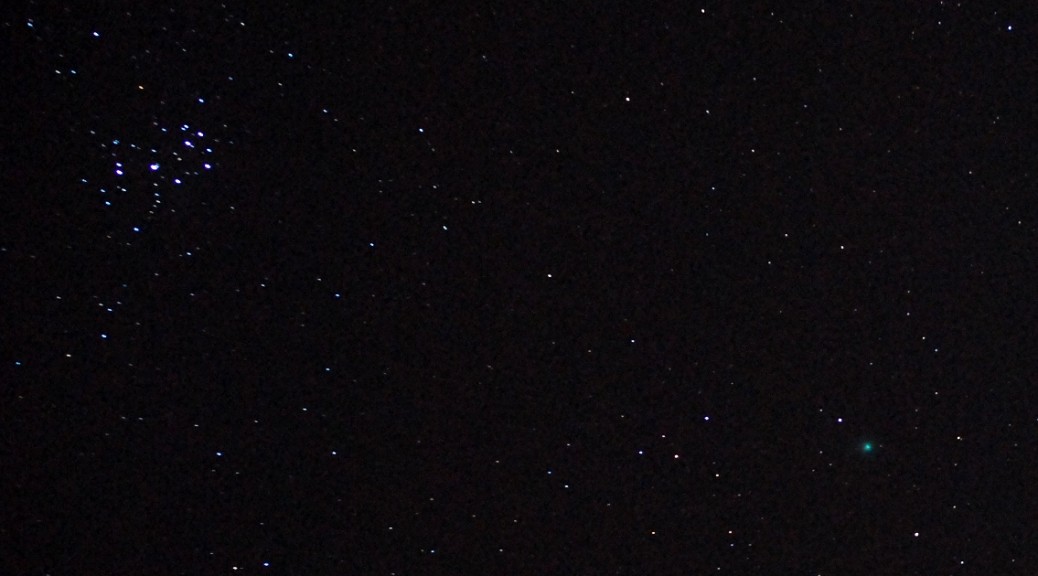
Comet Lovejoy (C/2014 Q2) delighted skywatchers in late 2014 and early 2015 with its vivid green glow and graceful ion tail. Discovered on August 17, 2014, by Australian amateur astronomer Terry Lovejoy, his fifth comet discovery, Lovejoy quickly brightened to become a naked-eye object, peaking around magnitude +4. The comet’s distinctive green coma was caused by sunlight exciting diatomic carbon (C₂) in its atmosphere, making it stand out even in binoculars and telescopic views. At its closest approach to Earth on January 7, 2015, it passed just 44 million miles away, then reached perihelion later that month on January 30.
Initially visible in the Southern Hemisphere, Comet Lovejoy became a striking presence in Northern Hemisphere skies as it passed through constellations like Orion, Taurus, and near the Pleiades. With an orbital period of roughly 8,000 years, it was a once-in-a-lifetime visitor for modern observers. Lovejoy was a vivid reminder that even in the modern space age, amateur astronomers can still make major discoveries that capture the imagination of millions.
I used a Nikon D60 (DSLR) piggybacked on a Meade ETX-90 and 200mm lens to capture this image of the comet on the evening of January 6th and 17th 2015. The Moon was very prominent in the sky on the 6th but the comet was easily visible in 10×50 binoculars and the ETX90. Click on any of the images below to go to the gallery for a better view.


