All posts by Scott

FREE & HELPFUL ASTRONOMY SOFTWARE

Looking to explore the night sky but don’t want to break the bank on expensive astronomy software? Look no further! In this post, I’ll explore some, but not all, of the top open source and freeware software options for amateur astronomers.  Discover all the features and tools you need to take your imaging to the next level without spending a dime.

There are plenty of fantastic and expensive software applications that provide “free trials” of 30-90 days before they entice you to pay for a license to continue to use them. And that’s fine.  If you don’t pay they’ll just make using them difficult by shutting off critical functionality or locking you out altogether until you do pay. I get it. You got to pay to play!  But these software titles below are all free to download and use with no restrictions, but please understand that most of these will also have an option to “donate or contribute” money to those hard working folks that have spent hours of their time to bring these “free” applications to you.

So if you find yourself repeatedly using one or several of these applications I highly encourage you to do as I have done – show them some love, hit the donate button and contribute to their cause.

Continue reading FREE & HELPFUL ASTRONOMY SOFTWARE

Annular Solar Eclipse – October 14, 2023

Eclipsed Sun through the clouds 10-14-2023
Eclipsed Sun through the clouds 10-14-2023.

On October 14, 2023 an annular solar eclipse was visible in the U.S. Much of the United States witnessed a partial solar eclipse as a result but those in the western portion of the country were better situated for a deeper and longer solar eclipse. Those along the narrow path of annularity were treated to an amazing “ring of fire.”

Unlike a total solar eclipse, annular solar eclipses occur when the Moon is slightly farther away from the Earth in its orbit.

Totality, Annular Solar Eclipse 10-14-2023
Total Annular Solar Eclipse 10-14-2023

This results in the Moon covering up the Sun but since it’s father away a thin ring of the Sun is still visible around the Moon. Thus solar filters must be used during the entire progression of an annular eclipse even when viewing in the path of annularity as the surface of the Sun is still visible round the outer edge of the Moon.

Continue reading Annular Solar Eclipse – October 14, 2023

The Tower of the Winds and the Gregorian Calendar

On a recent vacation trip to Rome I was lucky enough to also visit the Vatican. Our group toured the Vatican Museums, Sistine Chapel, St. Peter’s Basilica, Papal Crypts and St. Peter’s Square. It was an amazing experience to be sure but one tower seen from the Pigna (Pinecone) Courtyard caught my eye. I had read about the “Tower of the Winds” and it’s historical importance in astronomy prior to our trip.

The Tower of the Winds at The Vatican
The Tower of the Winds or the Gregorian Tower was constructed in 1580 and is located in the Vatican.

The Tower of the Winds, also known as the Gregorian Tower, is a prominent structure in the Vatican Gardens in Rome. The tower was designed by the famous Jesuit German mathematician and astronomer Father Christopher Clavius and built in the late 16th century. Its primary purpose was to serve as an astronomical observatory for the Vatican, as well as a platform for viewing Rome.

The Tower of the Winds was equipped with several astronomical instruments, including a meridian line, a solar quadrant, and a celestial globe. These instruments allowed astronomers to accurately measure the position of celestial bodies and to determine the time of day with great precision.

Continue reading The Tower of the Winds and the Gregorian Calendar

Visiting Stonehenge

I had been looking forward to visiting this site for years and as it turned out I had my chance in the spring of 2022. It was a bucket list item for me, and it did not disappoint.

Our driver took us to Woodhenge which is about 2 miles from Stonehenge. We stopped but it was raining so hard that we couldn’t even get out of the van. So on to Stonehenge we went, and while the sky still had a “spring shower at any moment” look to it, the rain ended and we were able to thoroughly investigate the visitor center, its surroundings and the ancient stone monument itself.

Continue reading Visiting Stonehenge

The Leviathan of Parsonstown

Back in May of this year we enjoyed beautiful weather while  visiting the “Emerald Isle.”  A couple of hours drive generally west of Dublin, Ireland is the town of Birr, and Birr Castle Demesne.

The Great Telescope at Birr Castle
The Leviathan of Parsonstown.

We took a guided tour inside the castle itself which is only offered during certain months of the year. The castle is not just an unoccupied museum piece but is the home of Brendan Parsons the 7th Earl of Rosse and his wife. The Parsons family have lived at Birr Castle since 1620. They celebrated their 400th anniversary last year.

We were able to walk and explore the extensive surrounding grounds or demesne (domain) which included award winning gardens, historic science center, I-LOFAR radio telescope, lake, river, waterfall, huge treehouse playground and the main attraction I was there to see, the The Great Telescope.

Continue reading The Leviathan of Parsonstown

Artemis I on Launch Complex 39B

Two trips to central Florida and the Kennedy Space Center in late August and early September with launch tickets in hand have unfortunately resulted in two scrubbed launch attempts of NASA’s first spaceflight of the Artemis Program.

Known as Artemis I, technically a flight test of the new Space Launch System (SLS) rocket that NASA will use to get back to the Moon.  This mission, if all goes as planned, should last 25.5 days and will take the unmanned Orion spacecraft to the Moon for a series of orbits and then back to Earth. Artemis I is the first in a series of increasingly complex missions that will enable human exploration to the Moon and Mars.

So why were the launch attempts scrubbed? An issue with one of the RS-25 engines not reaching adequate temperature halted one. The RS-25 rocket engines are the same powerplants once used by the Space Shuttle. They are the three big engines found on the back of the orbiter. There are four that are used on the SLS. Leaks during the fueling process caused the other attempts to be scrubbed. Then Hurricane Ian popped up on the radar and it was decided to call in the massive crawler to move the rocket stack back to the Vehicle Assembly Building to ride out the storm. As of this writing that is where Artemis I sits today.

However, things are starting to spin back up after Ian demolished much of the west coast of Florida and NASA announced today that the next attempt to launch Artemis I will come very early on Monday, Nov. 14 during a 69 minute launch window which opens at 12:07 a.m. EST. NASA has said that they plan to transport the rocket back to Launch Complex 39B as early as Friday, Nov. 4.

The gallery above contains a few shots of Artemis I as seen from the Apollo Saturn V Complex at KSC and from across the Indian River in Titusville, FL.

My First Dedicated Astronomy Camera

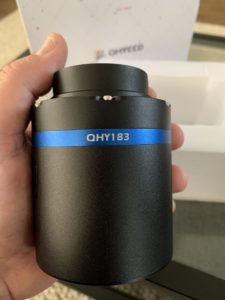
QHY183C
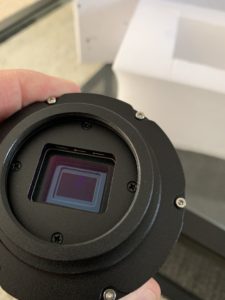
QHY183C sensor.

After having used a DSLR for astrophotography for as long as I can remember I decided to step things up a notch and get a dedicated astrophotography camera. The benefits over the DSLR seemed well worth the trouble of making the change.  The ability to cool the sensor and reduce noise while taking long exposures and the increased megapixel count from my Nikon D5100 were just a  couple of reasons.

QHY183C
QHY183C

So I weighed the options between choosing a CCD (Charged Coupled Device) or CMOS (Complementary Metal Oxide Semiconductor) camera. There are pro’s and con’s associated with both devices. I won’t run down that rabbit hole in this article but I will point out that the CMOS devices have come a long way in the past decade where CCD’s typically dominated. I think it’s a fair statement to say that CCD’s were the standard high-end digital imaging device not too long ago, and at the same time they were very expensive and thus not within easy reach of most backyard imagers. CCD’s are still in use and provide amazing images but the cooled CMOS cameras with their relatively lower price have become the new standard used by amateur astronomers.  Following that lead as well as my budget pointed me to a CMOS camera.

Continue reading My First Dedicated Astronomy Camera

A Possible Meteor Storm Monday?

Bright meteor captured with a GoPro during a nightlapse in August 2021 at Turks and Caicos Islands.

The Tau Herculids meteor shower produced by its parent comet 73P/Schwassmann-Wachmann 3, or SW3 peaks this Monday night for those in the DFW area. Discovered in 1930 SW3 orbits the sun every 5.4 years.  It’s not a bright comet but it’s an interesting one at the moment given it’s potential for a meteor storm Monday.

In 1995, astronomers watched as this comet began to fracture and litter its orbit with a cocktail of rock, dust and ice debris. It’s fragments from this 1995 event as well as debris streams from 1897 and 1892 that COULD produce a meteor storm late Monday evening May 30, 2022.  This is by no means a done deal. Several pieces of data point toward a possible meteor outburst and hope is high but we cannot be sure whether or not this will actually happen. If it does happen you’re going to want to see this for sure.

Continue reading A Possible Meteor Storm Monday?

Meade’s LXD55 + 20 Years

Meade LXD55 10″ Schmidt-Newtonian

I realized recently that I’ve  been a Meade LXD55 Schmidt-Newtonian telescope owner for just shy of two decades now. Wow! “That’s hard to believe,” I thought. It got me to thinking about the telescope, and it dawned on me to write about the LXD55 scope & mount.

Meade’s LXD55 line of scopes, and maybe more importantly, the GOTO German equatorial mount (GEM) was all the talk back in late 2001 and 2002 when the company began advertising it in the usual magazines. However, Meade had an issue getting the units to market and in the hands of eager amateurs chomping at the bit to have a GOTO mount that wasn’t going to break the bank.

I’m not entirely sure why the promised release date was pushed back. Maybe it was manufacturing delays or there was something else afoot but only a smattering of scopes and mounts were initially released. What I painfully knew at that time was my order had not been filled and the delivery date kept getting pushed back. If I recall correctly, (this was 20 years ago) I think I ended up waiting an additional 6 agonizing months before my shiny new telescope finally shipped. Receiving the scope was another tragic story entirely which you can read about here.

Continue reading Meade’s LXD55 + 20 Years

Astrophotography with a GoPro?

The camera’s that are now showing up in cellphones and action cameras such as GoPros have come a long way over the years. You’ve probably seen the TV commercials for the Google Pixel producing some amazing star-filled photos.  In this article I’ll focus on using a GoPro rather than a cellphone to capture astronomical images and time lapse videos.

GoPro HERO 8 BlackI have a GoPro HERO 8 Black and while it does have limitations it can produced some pretty cool astro images.

The HERO 8 Black at this writing is now a couple of years old and the HERO 10 is the latest model offered. If you are in the market for a GoPro I’d recommend the HERO 9 or 10. I have heard that the hot pixel issue discussed later in this article has been addressed or is not near as prominent in those newer models.

The HERO 8 is a waterproof (down to 33ft) action camera with HyperSmooth 2.0 video stabilization. It has a 12 megapixel camera that is capable of shooting 4K video at 60 fps.  Other built-in features include Time lapse, Time warp and Night lapse modes. There are also digital lens options including Narrow, Linear, Wide and Super View allowing the user to select the best view size for the setting.

Continue reading Astrophotography with a GoPro?